


If you need furniture manufacturing services, you may need to choose between OEM and ODM services.
As a long-term practitioner deeply engaged in connecting with China’s furniture manufacturing industry, I have cooperated with dozens of OEM and ODM factories at home and abroad over the years. This article will start with the core differences and data between OEM and ODM, and teach you how to choose between OEM and ODM.
Core Differences :OEM vs ODM
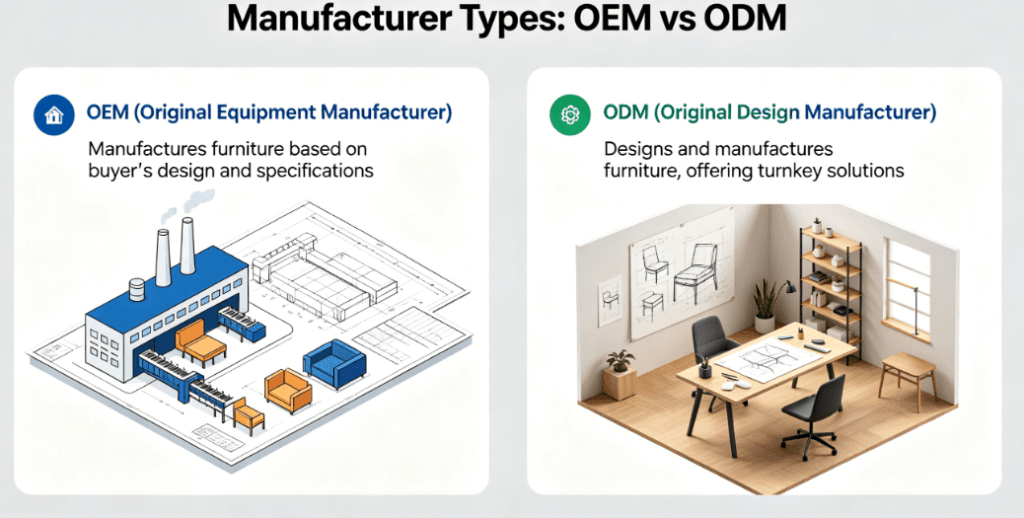
Simply put, OEM (Original Equipment Manufacturer) is “contract manufacturing”. You provide a complete design plan—from CAD drawings to material specifications—and the factory only produces according to your requirements, with all intellectual property rights (IP) belonging to you. ODM (Original Design Manufacturer), on the other hand, means the factory provides ready-made design plans. You can make minor adjustments to the design and brand it with your own logo, but the intellectual property rights of the basic design belong to the factory unless an exclusive agreement is signed.
Data on OEM and ODM of Chinese Furniture Manufacturers
International data is more convincing. According to the 2024 industry report released by the Global Furniture Union (GFU), Chinese furniture OEM and ODM manufacturers account for more than 75% of the global contract manufacturing market, among which the number of ODM enterprises exceeds 320. Data from international market research institute Statista shows that the global furniture contract manufacturing market size reached 89 billion US dollars in 2024, with China contributing 66.75 billion US dollars, accounting for more than 75%; among them, small and medium-sized OEM/ODM enterprises account for 62%, but due to fierce market competition, the average profit margin is only 4.8%.
How to Choose Between OEM and ODM?
Based on my practical experience, the OEM model is most suitable for brands with their own design teams. For example, the world-famous home furnishing brand IKEA entrusts OEM factories in Foshan, China to produce many of its classic bed frames, and the factories only are responsible for production execution. This is a typical OEM cooperation.
Take Guangdong Jianmu Furniture as an example. This factory is an OEM manufacturer for Baker, the brand favored by the White House, and produces completely according to Baker’s design drawings. In addition, Huzhou Henglin Home Furnishing is also a well-known OEM factory, which has long been an OEM for international brands such as IKEA and Edley, and all production is carried out in accordance with the design requirements of the brand side.
Most of the international high-end furniture brands I have worked with choose the OEM model to protect their unique designs. These factories are mainly concentrated in Guangdong and Zhejiang, with complete export qualifications, and their products meet international standards such as EU CE and US CARB P2.
The ODM model, on the other hand, is more suitable for brands without design capabilities. I have seen some international small and medium-sized retailers prefer ODM cooperation—the factory provides ready-made designs for sofas, cabinets, dining chairs, etc., which can be put on the market only by pasting their own brand and making minor adjustments. ODM factories in Zhejiang and Jiangsu, China have the most advantages, with high cost performance and fast delivery.
For example, Foshan Dingge
., originally a factory focusing on mattress OEM, later transformed into the ODM model. It has successively provided ODM manufacturing services for 600 hotels and 39 hotel institutions, and also provided ready-made design and labeling cooperation for Lixing, Sleemon and other brands. Another example is Jiangsu Skylin Furniture, which is an ODM manufacturer for Markor Home Furnishing and Sam’s Edley, providing ready-made designs such as electric leather sofas.
Key Reminders
Based on my experience, there are two key reminders I must tell you:
First, intellectual property protection. For OEM cooperation, it is necessary to clearly specify in the contract that the intellectual property rights belong to you. For ODM cooperation, if you want to avoid the same products as competitors, you must negotiate exclusive authorization.
Second, factory qualification verification. You can verify the third-party inspection reports approved by CNCA through the National Certification and Accreditation Information Public Service Platform (https://cx.cnca.cn).