


Japandi furniture is less a fleeting design trend and more a profound philosophy of living. Against the backdrop of global trade, residential design has evolved toward a seamless blend of Eastern and Western sensibilities, forming a distinctive interior aesthetic.
The iconic East-meets-West residence crafted by WOLF Architects embodies this cross-cultural design ethos. Its exterior follows Western modernism: expansive raw concrete, frameless glazing and crisp geometric planes. Step through the front door, however, and you are greeted by a contemporary karesansui dry landscape garden, complete with a small bridge spanning a dry stream. Double-sided fireplaces and artistic glass partitions further define spaces — open and airy, yet preserving the layered spatial logic of traditional Eastern architecture.
Internationally acclaimed designer Kelly Hoppen has created countless ultra-luxury private residences. Her architecture and hard finishes feature exceptionally clean, symmetrical, sharp lines, drawing heavily on hallmarks of Western modern construction. Meanwhile, her soft furnishings build on a base palette of taupe, beige, black, white and grey, infused with the Eastern philosophy of yin and yang.
By 2027, Japandi continues to evolve. Many designers have moved past its earlier generic look toward culturally richer, more tactile iterations: Wabi Japandi and moody dark Japandi.
REGISTER NOW For FREE! :https://www.cifffurniturefair.com/the-57th-china-international-furniture-fair-guangzhou/
I. Market Data: Why Japandi Remains a Leading Trend in 2027
Latest industry reports show steady expansion across the global furniture market, projected to surpass USD 629 billion between 2026 and 2027. The Asia-Pacific region accounts for nearly 49% of the global market share. Premium wood furniture manufacturing supply chains across China, Japan and Southeast Asia lay the craft foundation for Japandi.
Tracking data from Pinterest and major design platforms reveals searches tagged Handmade Pottery Japandi and Wabi Japandi surged over 70% year-on-year. This suggests urban dwellers are increasingly willing to allocate interior renovation budgets to Japandi schemes featuring natural materials and bespoke aesthetics, and to pay a premium for them.
II. Core East-West Fusion Trends of Japandi in 2027
1. Material Philosophy: Wabi-Sabi — Beauty in Imperfection
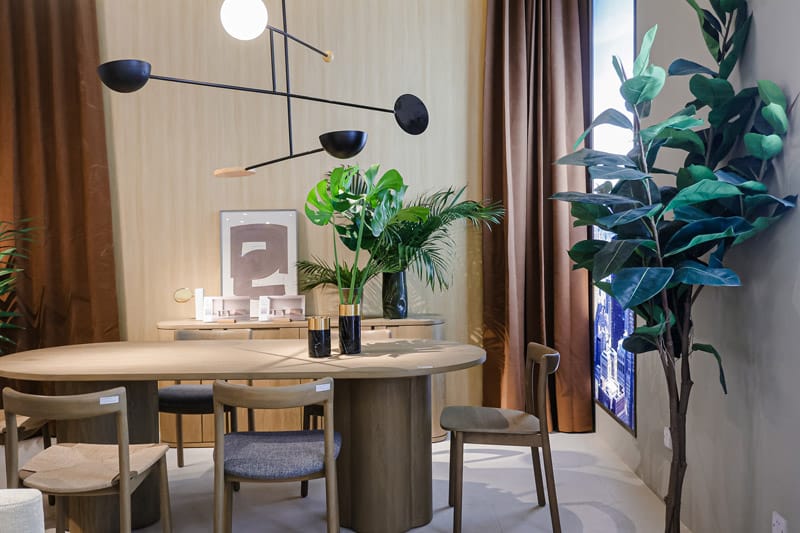
2027 Japandi furniture reduces mass-produced industrial elements, embracing natural, beautiful flaws. The emphasis shifts toward handcrafted character and organic grain: solid timber bearing subtle tool marks, hand-thrown rustic ceramics, and raw wood without over-polishing.
2. Colour Aesthetics: Mushroom Taupe and Dark Japandi with Zen Undertones
Warm, earthy mushroom taupe continues to grow in popularity. Meanwhile, Dark Japandi is gaining traction in high-end private homes. The look pairs charred timber veneers, dark walnut and smoked oak with feature walls in deep olive green to craft restrained, zen-inspired interiors.
3. Spatial Flow: Fusion of Eastern Raised Platforms and Western Modular Sofas
Overall visual mass within homes is kept low. Low-profile platform beds, slim-legged sofas and low cabinets sitting 20 cm above the ground maintain unobstructed sightlines. Japanese tatami platforms, zaisu legless chairs and low tables are being integrated into Western open-plan penthouse layouts.
4. Spiritual Resonance: Blurring Boundaries with Nature
For all their differences, Eastern and Western design traditions share reverence for nature. 2027 Japandi treats indoor miniature landscapes, karesansui garden motifs and Japanese bonsai as integral structural elements of the space.
Case Study The Japandi apartment renovation in Potts Point, Sydney, is one of the most celebrated examples in interior design. Led by Mr & Mrs Elias, the project transformed a cramped, poorly lit urban apartment into a modern home merging Eastern nature and Scandinavian functionalism.
The original space had a conventional closed kitchen with convoluted circulation that felt confining. The design team demolished this layout entirely, introducing Scandinavian open-plan flow to let daylight flood the interior. Light natural timber flooring offers a soft surface for bare feet while grounding the space in nature.
Selected wall corners use low-saturation micro-cement or decorative plaster, creating hand-finished textures reminiscent of rice paper or traditional earthen walls. This treatment perfectly mirrors the Japanese appreciation of imperfection.
Abundant concealed storage replicates Japanese organisational principles. Cabinet doors, appliances and clutter are fully recessed into walls or timber veneers, delivering minimalism without sacrificing practicality.
III. Conclusion & Industry Insights
For furniture manufacturers, designers and export-focused brands, 2027 Japandi represents a test of supply chain craftsmanship, material selection and the ability to reconcile Eastern and Western lifestyles.