


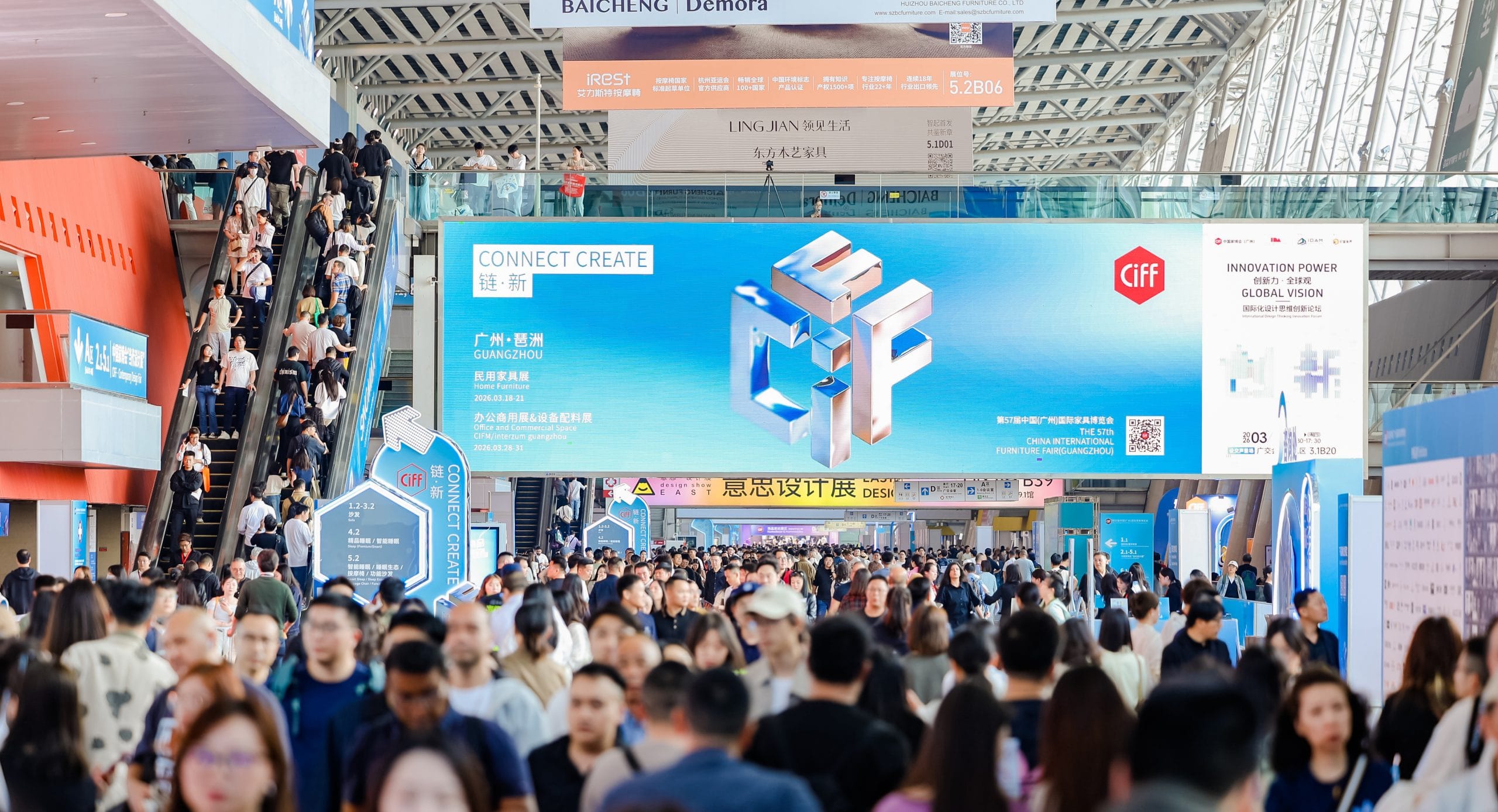
China’s furniture exhibition landscape falls into two clear tiers: world-class flagship expos represented by CIFF and Furniture China, and regional specialized fairs including Dongguan International Famous Furniture Fair, Chengdu International Furniture Industry Fair and Shengfang Furniture Fair [4].
I. Tier Classification of Mainstream Furniture Exhibitions in China
1. CIFF (China International Furniture Fair, Guangzhou & Shanghai)
Spanning over 850,000 sq.m of gross exhibition space annually, CIFF ranks among the world’s largest end-to-end furniture expos covering the full industrial value chain [1]. It operates two annual sessions: a two-phase Guangzhou edition every March, and a single Shanghai edition every September. Its exhibit portfolio comprehensively covers residential furniture, office & commercial furniture, outdoor living, home décor & textiles, plus manufacturing machinery and raw materials via the concurrent CIFM/interzum guangzhou platform [9].
Matthias Pollmann, Vice President of Exhibition Management at Koelnmesse GmbH, commented on interzum guangzhou:
“As a pivotal global anchor of the interzum trade fair series, interzum guangzhou reshapes the landscape of Asia’s furniture industry. The expo unites elite furniture manufacturers worldwide to advance green smart manufacturing and cross-border industrial collaboration, building a more structured, sustainable industrial ecosystem” [3].
REGISTER NOW For FREE! :https://www.cifffurniturefair.com/the-57th-china-international-furniture-fair-guangzhou/
Frederik Meyer, President of EUMABOIS (European Federation of Woodworking Machinery Manufacturers), added:
“interzum guangzhou serves as an indispensable global hub for industrial innovation and cross-border partnership building. Amid volatile global market shifts, international exchange and collaboration are the core engine translating creative concepts into tangible market competitiveness” [3].
2. Furniture China (Shanghai International Furniture Fair)
Hosted in Shanghai each September, Furniture China focuses on mid-to-high-end finished furniture, international designer brands and avant-garde design concepts. It occupies 300,000–350,000 sq.m of exhibition space and hosts over 3,000 exhibitors per session [2].
3. Dongguan International Famous Furniture Fair
A leading platform for high-end custom furniture manufacturing. Its integrated exhibition and trade complex exceeds 700,000 sq.m, with two annual sessions held in March and August. Its core strengths lie in whole-house customization, premium manufacturing, brand franchise recruitment and commercial project delivery solutions [4].
4. Shenzhen Fashion Home Design Week
Staged in March or June each year in Shenzhen, this event centers on spatial design, soft furnishing accessories and lifestyle aesthetics. It is China’s benchmark expo for commercializing avant-garde interior design concepts.
5. Chengdu International Furniture Industry Fair
With an exhibition footprint of 100,000–150,000 sq.m, the fair attracts 150,000–200,000 domestic trade visitors per session every June. Widely recognized as a core domestic furniture trade hub, it targets dealers across China’s central, western and second-to-fourth tier cities, catering closely to mass consumer market demand [5].
II. Dimensional Comparison Between CIFF and Other Leading Furniture Fairs
1. Completeness of Industrial Chain Coverage
CIFF
It is one of very few supersized expos in the industry delivering full upstream-to-downstream supply chain coverage [7]. The Guangzhou event is split into two phases: Phase 1 showcases residential furniture, home textiles & décor and outdoor furnishings; Phase 2 features office & commercial furniture alongside the dedicated CIFM machinery and raw materials exhibition [9]. Buyers can source finished furniture, plus upstream inputs including production equipment, fabrics and hardware fittings all under one roof.
Ali Al-Khazaali, Founder of a London-based furniture retail chain, shared his feedback on CIFF:
“I flew 12 hours from the UK to Guangzhou, and I cannot wait to explore the world’s most innovative, contemporary furniture collections showcased at CIFF.”
Industry analysis supplements this observation: Global buyers from Europe and North America consistently prioritize CIFF because the expo consolidates hundreds of thousands of square meters of factory exhibits and new product launches within a few days. Rather than traveling across multiple cities or countries to source suppliers separately, buyers can condense six months of procurement due diligence into a matter of days [1].
Furniture China (Shanghai) & Shenzhen Fashion Home Design Week
These two events concentrate primarily on midstream finished furniture and soft furnishing design, with only minimal displays of large-scale woodworking machinery and heavy upstream production equipment.
Regional Fairs
Regional expos adopt a niche vertical strategy, focusing deep supply chain development for single categories such as dining set components and single-item furniture manufacturing.
2. Trade Orientation & International Reach
CIFF (Guangzhou & Shanghai)
It draws overseas buyers spanning more than 180 countries and territories, with annual foreign visitor volumes regularly hitting 50,000–60,000, accounting for a substantial share of total attendees [7]. It stands as the premier sourcing platform for cross-border bulk orders and OEM/ODM manufacturing partnerships.
Furniture China (Shanghai)
While it also boasts robust international buyer traction, its audience skews toward high-end European and American purchasers and specialist design-focused buyers.
Chengdu Furniture Fair & Shengfang Furniture Fair
Their core value lies in enabling small and medium-sized domestic furniture factories to distribute goods to furniture retail outlets and dealer networks nationwide.
3. Fair Operation Model
CIFF & Furniture China (Shanghai)
Exhibitors hail from every region of China and across the globe. Business negotiations between buyers and factories continue nationwide long after the exhibition closes.
Dongguan Famous Furniture Fair & Foshan Longjiang Furniture Fair
Venues sit adjacent to concentrated industrial clusters. After viewing samples on-site, buyers can reach supporting factories and standalone brand showrooms within a 30-minute drive to conduct on-site production audits and project evaluations.
III. Enterprise Booth Selection Decision-Making & Typical Strategic Frameworks
- Target full-category product exposure, elevate industry market positioning and secure large-scale global export orders: Prioritize CIFF.
- Focus on premium finished furniture, expand European and American market channels and boost design-led product premium: Prioritize Furniture China (Shanghai).
- Leverage local manufacturing cluster advantages and develop high-end custom & commercial project businesses: Prioritize Dongguan Famous Furniture Fair or Shenzhen Fashion Home Design Week.
- Penetrate China’s domestic distribution channels across second-to-fourth tier cities and drive mass-volume single-item sales: Prioritize Chengdu Furniture Fair or Shengfang Furniture Fair. These events feature lower exhibition costs, enabling rapid nationwide distribution with cost-effective mass-market products [5].
Reference
[1] Official data & press releases of China International Furniture Fair (CIFF Guangzhou & Shanghai), Koelnmesse (Beijing), 2024–2026
[2] Industry overview report of Furniture China (Shanghai International Furniture Fair), Shanghai UBM Exhibition Co., Ltd., 2025
[3] On-site interview records of interzum guangzhou summit, European Federation of Woodworking Machinery Manufacturers (EUMABOIS), March 2026
[4] National Furniture Channel Annual Sourcing Report, China National Furniture Association, 2025
[5] Regional furniture exhibition operation whitepaper, Domestic Home Furnishing Circulation Research Institute, 2025
Disclaimer
This document is compiled based on official exhibition briefings, industry interviews and third-party supply chain research materials for reference only. It does not constitute any investment, exhibition participation or commercial cooperation advice. All brand trademarks, exhibition names and executive quotations belong to their respective holders. Readers shall bear all commercial decision risks arising from referencing this content.