


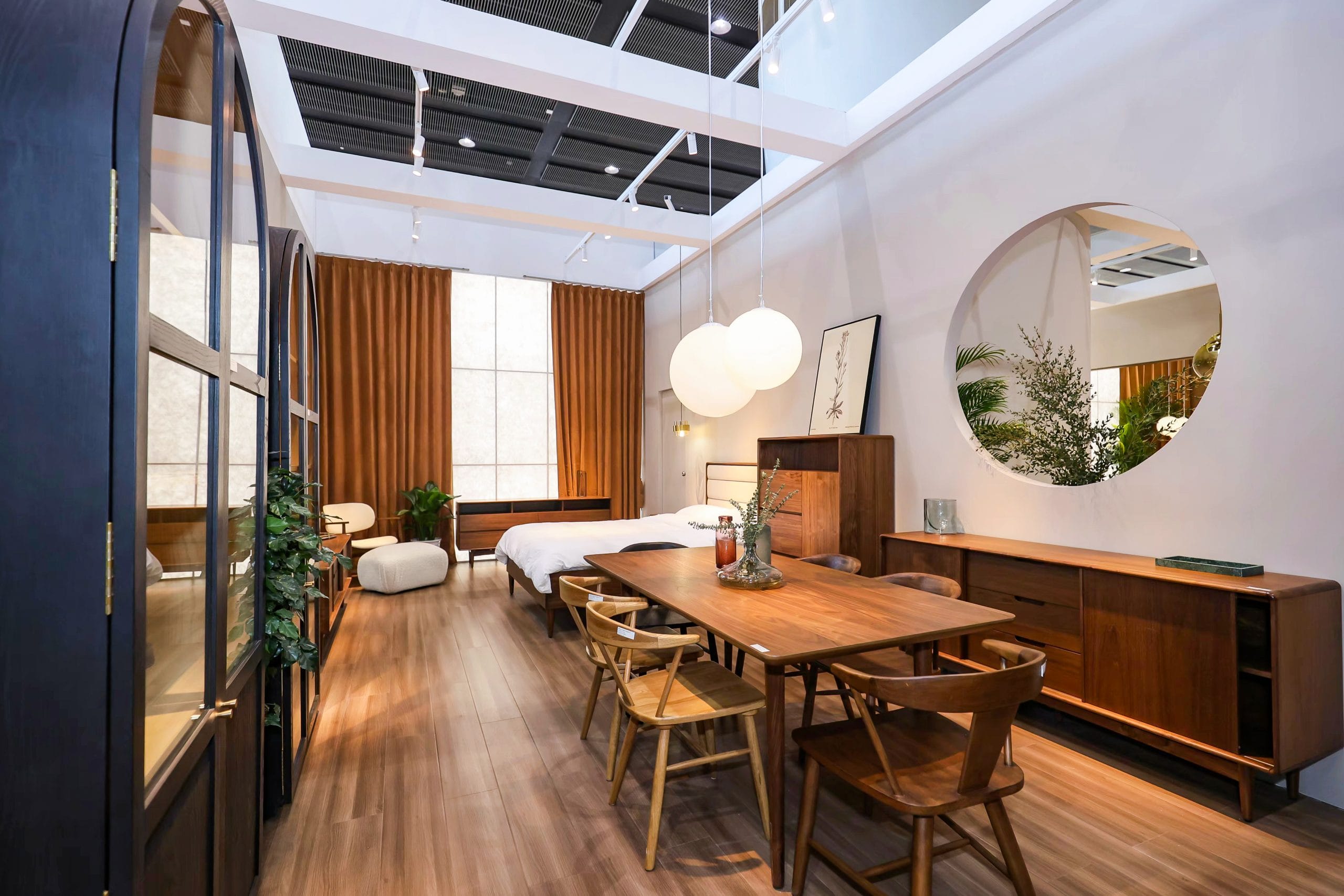
According to authoritative industry data reports for 2026, China’s wood furniture manufacturing industry is transitioning from large-scale expansion toward high-quality development.
As the core category accounting for the highest proportion of output value in China’s furniture industry (approximately 49.8%), wood furniture is highly representative of the country’s technological iteration. This guide will provide an in-depth look at the current development status and future outlook from macro perspectives, including data scale, industrial status, and industrial clusters.
I. Market Scale and Global Industry Status
Despite the negative impacts and uncertainties brought about by international trade disputes, China’s total furniture exports reached approximately $64 billion in 2025, accounting for 30.8% of the global furniture export market share. Among these, wood furniture remains the highest-value material category for exports, leading by a significant percentage over other materials such as aluminum.
In terms of output value estimates, the total value of the Chinese furniture market was approximately $92.43 billion in 2025. It is projected to grow to $130.5 billion by 2032, representing a Compound Annual Growth Rate (CAGR) of 5.92%.
II. Core Industrial Regions for Chinese Wood Furniture
South China (Guangdong): Centered around Foshan and Dongguan, this region leverages export-oriented strategies and a mature industrial chain. Large factories here possess extensive import/export experience, emphasizing design alongside excellent cost-performance ratios. Industrial clustering not only provides price advantages but also results in shorter manufacturing cycles compared to other global production regions, offering high flexibility and rapid response times.
East China (Zhejiang, Jiangsu, Shandong): Zhejiang ranks first in export volume (accounting for 28.4%), largely due to its highly developed local e-commerce industry. Shandong is renowned as a major production base for solid wood furniture.
Southwest China (Sichuan): Solid wood furniture from the Chengdu/Xindu area primarily serves the domestic market and exports to “Belt and Road” countries. Export growth in this region was notably significant in 2025.
III. Four Core Trends in 2026
1. The Rise of “New Solid Wood”:
Consumers are no longer solely pursuing rare rosewood (Hongmu). Instead, they are shifting toward designs that emphasize structural aesthetics and eco-friendly materials. As small-apartment living becomes more common, high-end modern solid wood furniture is increasingly favored.
2. Environmental Protection and Safety:
Today, more solid wood manufacturers are universally adopting E0-grade panels, striving for zero formaldehyde emissions.
3. Smart Manufacturing (Industry 4.0):
The automation penetration rate among major furniture enterprises in China has reached 72%. Through flexible production lines, manufacturers can achieve Mass Customization and small-batch customization for customers at a lower cost.
4. Niche Market Opportunities:
Niche segments such as Home Office, Pet Furniture, and Smart Height-Adjustable Desks recorded excess growth of over 3.5% between 2025 and 2026.
IV. Overseas Expansion and Trade Dynamics
The reliance of Chinese wood furniture on the U.S. market is gradually decreasing. This is due to the fact that exports to “Belt and Road” and ASEAN countries have increased to 35% of the total, while exports to European countries have risen against the general trend.
Industry Summary:
In 2026, China’s wood furniture manufacturing industry is no longer merely the “world’s factory.” Through original design and digital supply chains, it is upgrading toward a high-value-added, brand-driven path.